Roy Buchanan Start All Over Again
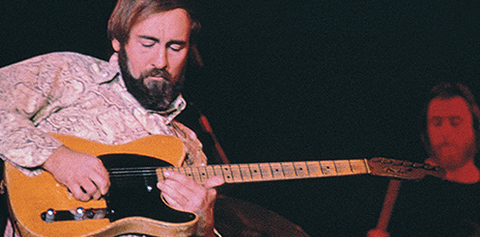

Roy Buchanan and his battered 1953 Telecaster guitar got inside your head and grabbed you in the gut. He had eclectic musical tastes, an arsenal of techniques, a devotion to craft, and something to say. And he said information technology with soul.
Those are mere generalizations, of course, and Buchanan commanded such diverse skills it is difficult to generalize about him. The unmarried impression emblazoned upon my mind, 25 years after seeing and hearing him perform for the first fourth dimension, is his emotive power – he conveyed feeling. Buchanan serenaded, saddened, exhilarated, riveted, and hypnotized his audiences, all in the infinite of an hour'southward operation at the small clubs he preferred. On his Tele he expressed the known range of human emotions and more, including intuitive matters of the eye and mind that defy description. In Buchanan's hands the Telecaster sang, soared, screamed, whispered and wailed like it never had earlier, or has since. He could play virtually anything he imagined, and his imagination knew few boundaries. He was that damn good.
Buchanan could be hypnotic, but that'south not to say his playing was exclusively ethereal or transcendent. On the contrary, information technology was often the gut-grabbing immediacy, the attention-enervating, trebly nature of his Telecaster sound that took country, blues, rock and roll, or annihilation else he tried someplace it hadn't been. In dissimilarity to many lead guitarists, his genius often poured forth as he backed a singer. Every bit a sideman, sometimes in his own band, he produced imaginative rhythm work and fills. When it came fourth dimension to solo, he equanimous riffs of astonishing dexterity and dazzler. Oftentimes he took time to craft them for maximum melodic and emotional result, for he had little compulsion to impress. At other times Roy came out, every bit one reviewer put it, "…with his pants on fire," cranking out commanding leads from the get-go. At the climax of a solo, he might go over the top, working the strings from the nut to the bridge, using all 5 fingers of both easily to create a mind-bending orgy of sounds. The fingers of his right hand could move in a fingerpicking mistiness that has been described by a one-time bandmate as resembling dancing spiders. He pioneered numerous techniques, from the pinched harmonic (or "squealer") to his manipulation of the Telecaster's simplified tone and volume controls to produce wah-wah effects that predated pedals by a decade.
Buchanan'south techniques stunned, puzzled and intimidated other players. Still, it was always his expressions – the musical and emotional effects he accomplished through technique – that gear up him apart. Roy had a way of playing a note, a chord, a whistling harmonic or a steel guitar-like lick at the precise moment information technology produced the greatest emotional bear on. It seems natural, in retrospect, that Buchanan made his mark primarily equally a performer, not a recording creative person. Though he made a few hit records, his music came alive on the phase of a darkened nightclub in a fashion that bred amore and loyalty in his audience, the devoted denizens of the midnight 60 minutes. He took listeners to places of ineffable dazzler, or seared them with tortured blues. Crowds rocked clubs to their foundations with demands for "More than!" Buchanan'south music was consistently soulful, searing and mysterious – words that describe both his guitar mode and his personality. 1 reflected the other.
Though many great electric guitarists might be said to combine technical virtuosity and emotive power, with Roy Buchanan there was always more than, and not all of it proficient. His seemingly boundless talents were matched by a penchant for forbidden fruits and a misreckoning predilection for anonymity. Sensibly, he enjoyed his privacy and time with family unit and kept fame and its bellboy pressures at arm's length. Neither skilful fortune nor bad luck ever changed Buchanan'south natural disfavor to the spotlight. One has to admire his humanity, even as forces beyond his command swept him up and pushed him onto center phase. After his "discovery" by diverse media in 1971 – xv years afterwards he began his professional career, a career that seemed permanently stalled – and recording and touring offers poured in, Buchanan told an interviewer, "This star business scares the hell out of me."
Roy'southward homespun approach often protected him, simply it besides took its cost. Through a combination of Scottish taciturnity, deep shyness, a sensitive spirit, a rural upbringing and a journeyman'south cynicism, Buchanan carved out a crooked path for himself, one strewn sometimes with obstacles of his own making. There is much to puzzle over in Buchanan'southward contradictory character, his extraordinary musical gifts, the ups and downs of his lengthy career and his horrible death. He could be humble and kind, and when he indulged his gustation for forbidden fruits he could be opaque, hard, even menacing. Asked about his past or his techniques, Buchanan ofttimes bent the truth – as whatever good storyteller does – to a point just shy of breaking. He dispensed his own brand of "state mojo" at will and, for the most part, people bought information technology. "Land mojo" could be a powerful thing. Every bit information technology turned out, still, it could non banish demons, or bend steel confined.

Despite all this, Roy Buchanan contributed every bit much as any private to the vocabulary of stone and roll. His work drew admirers from every field in popular music, from rock and roll heroes to jazz stylists, from R&B belters to country rednecks, from stars to anonymous fellow journeymen. The firmament of stars who discovered in Buchanan the essence of American roots music included John Lennon and Paul McCartney. The Rolling Stones, then it is said, asked Buchanan to join their band (he is said to accept declined). Eric Clapton saw Buchanan perform once and proclaimed him "…the all-time in the world." Buchanan set a youthful Robbie Robertson (later of the Band) on a stylistic course of his own. Jerry Garcia of the Grateful Expressionless touted Buchanan's "…amazing chops." Jeff Beck learned Telecaster techniques from him, became a friend, and continues to concord him in awe. In jazz circles – not often a source of admirers for stone and roll players – Les Paul, Charlie Byrd, Barney Kessell, and Mundell Lowe were quick to recognize and praise Buchanan's talents (and they notwithstanding do).
These nods might embarrass or seem ridiculous to Buchanan, were he still live, for his modesty and matter-of-factness matched his musical talent. In fact, in a career that reached from the inception of rock and roll in the mid '50s to rock'south tattered shadow in the '80s, Buchanan caused a reputation in small but knowledgable circles as 1 of the very best. Withal on the night of his death he remained as anonymous to the general public every bit he had been throughout his life.
So the story of Roy Buchanan's life and times follows a hard route riddled with pathos. Nevertheless nosotros must permit room for warmth, sense of humour, and compassion because he himself so ofttimes exuded those traits. Buchanan was a uncomplicated state boy who, despite life's hardships and disappointments, wished to alive a private life. In any effort to understand this circuitous creative person and his contributions, one theme seems credible: Roy Buchanan and his music and guitar playing should be described and appreciated, if not explained, as the sum of sure quintessential American influences. A sense of place is important. Growing up in rural Arkansas and California shaped him in the traditions of country music. His urban explorations in Los Angeles, Shreveport, Chicago, Toronto and Washington, D.C. provided access to blues, rhythm and dejection, and jazz. Hit America's roadhouse circuit in '56, at the dawn of rock and roll, propelled him on an odyssey of road trips that lasted 32 years – an unusually long career in which he connected to evolve and garner new audiences and admirers.
That story, though it is simply 1 homo'south life, has wider implications. Following it illuminates the travails of this country's working musicians, the men and women who are somehow compelled nighttime after dark to produce joy for millions, despite the overwhelming odds that such a pursuit virtually guarantees perpetual anonymity, poverty, and perhaps, an early grave.

Roy Buchanan was born Leroy Buchanan on Sept. 23, 1939, in rural Ozark, Arkansas, which straddles the Arkansas River in the northwestern corner of the state. Today, Ozark remains a sleepy, peaceful place, but you can get there via highway. In the '30s, past contrast, "Goin' to Ozark was like goin' to Prc!" said one local.
Leroy's begetter, Bill Buchanan, was of Scottish extraction and farmed the river bottoms there as a sharecropper during the Depression. Nib and his married woman, Minnie Bong Reed, eventually had iv children: J.D. (born in '26), Betty ('33), Leroy ('39), and Linda Joan ('44). Two years later Roy'southward birth the family unit moved to Pixley, California, in the center of the San Joaquin Valley, where Pecker worked as a farm laborer. In Arkansas, sharecroppers kept a share of the crops they raised and paid the balance to the landowner, while in California laborers followed the harvest in a thousand fields belonging to others. Roy himself would i day tell the fib that his begetter had been a preacher, a story repeated always since by writers who never asked questions (J.D. Buchanan once told me, "If my male parent e'er went into a church, the roof'd fall in on him!").
Minnie tried to improve her children's lives by getting Leroy music lessons. He'd flirted with the guitar when he was about v years old, learning a few chords. At historic period nine, Leroy's folks got him a red Rickenbacker lapsteel and lessons from Mrs. Clara Louese Presher, an itinerant music teacher from nearby Bakersfield. Leroy took lessons for iii years. Near the end, Mrs. Presher found out that Leroy had never learned to read music. Instead, he had learned his lessons by ear and repeated them note-for-note. She broke down and cried. But she imparted a lesson Buchanan never forgot. "If I can't feel the music, I can't play," he in one case told an interviewer. "Mrs. Presher was really into that. She would say, 'Roy, if you don't play with feeling, don't play it.'"
Leroy listened to steel players on the radio and grooved to Jerry Byrd and others who fabricated steel guitar part of modernistic country music. Nearby Bakersfield had its ain distinct country sound, flavored by Telecaster guitar players like Buck Owens and Roy Nichols. Leroy absorbed it all and impressed school assemblies and church building recitals with his ability to play the steel guitar parts to any song on the radio. "He played all the Hank Williams songs that were playin' dorsum then simply exactly like they were on the tape," said Freddy Ramirez, a childhood friend.
Marvin and Paul Kirkland hired Leroy to play lapsteel in their band, The Waw Nifty Valley Boys, in '50 or '51. Leroy was about 12 years sometime and dark afterwards night he stole the prove. About '52 he picked up a standard, flat-elevation guitar and learned to choice in the Roy Nichols way. Within a couple years he experienced the blues on a jaunt to Stockton, California, with his older brother.
At high schoolhouse, Leroy put together a band called The Dusty Valley Boys, with buddies Darrell Jackson and Bobby Jobe, and so he and Jobe got professional person piece of work in the San Joaquin'due south honky tonks with bandleader Custer Bottoms. Leroy'south interest in the guitar eclipsed his interest in schoolhouse and by historic period xvi he'd left home for Los Angeles to stay with his older sis and brother. He took his Martin audio-visual and a hollowbody Gibson electric. By this time he could make his electrical guitar audio similar a steel, curve strings, and play anything he heard on the radio. The radio was playing new sounds, like Elvis Presley'southward "Mystery Train." Rhythm and dejection had given birth to the frenzied sounds of stone and roll, and Buchanan wanted a piece of information technology.

A Hollywood shyster named Bill Orwig hustled Leroy Buchanan into a cheesy rock and curl orchestra with drummer Spencer Dryden (later of the Jefferson Airplane and New Riders of the Purple Sage) called The Heartbeats. This band can be seen briefly in the loopy period film, Stone, Pretty Infant.
"Nosotros had a like honey of rhythm and dejection and downwards dwelling house rock and roll, and so we striking it off real well," said Dryden. "We had a band and all of a sudden we're making coin! This is at the kickoff of everything. 1956. Elvis is king. James Dean is still live. Bobby sox and rock and whorl. Everybody was looking for an in. None of us knew what we were doing. But Bill Orwig had a scheme."
Orwig'southward scheme, essentially, was to rip off The Heartbeats and brand coin for himself. When Orwig stranded the ring in Oklahoma Urban center it was every homo for himself. Roy nabbed a job as staff guitarist on "Oklahoma Bandstand" in Tulsa. The Human being Tornado – Dale Hawkins – made an appearance, capitalizing on his super hit, "Susie Q" (recorded with James Burton the year before), and Buchanan followed him to Shreveport. Thus began Buchanan's real rock and coil career. In June of '58 Hawkins and Buchanan recorded Willie Dixon's "My Babe" (a hitting for Little Walter in '55) at Chess Records in Chicago, Roy's first commercial recording. His edgy, dead-pollex intro and his Scotty Moore-fashion cascading notes all the same sparkle.
Hawkins and Buchanan toured the country for most ii years, Dale honing his stage operation, Roy whipping out the best rock and roll licks anyone had always heard. Of form, Hawkins had a reputation for picking guitarists, and a litany of greats filled that spot before and after Buchanan: Sonny Jones, James Burton, Carl Adams, Kenny Paulsen, Scotty Moore, and Hank "Sugarfoot" Garland, to proper noun a few. Hawkins and Buchanan learned to drink, fight, and slumber sitting up in a station railroad vehicle doing 60 miles per hr, and to take little white pills that eased a barbaric rock and whorl lifestyle. And of course they learned how to bring the house down every night. Rock and roll required a lot of sweat and blood to make it skillful.
"I was one of the hardest task masters in the world," Hawkins told me with a difficult look in his eye. "After each set we'd have a coming together and I would go over whatever went incorrect. And go over information technology and over information technology. I was one of the few people that could handle Roy. Non physically, but spiritually. I could make him play what I wanted." Hawkins wanted a band that knew how to dorsum him, but which could break loose on cue. "I was adequate, but Dale would really make you work," Roy would call up afterward. "He wouldn't get out y'all alone for a second and I was all for that."
The side by side few years found Roy and famed studio bassist Joe Osborn (VG, October '98) in a succession of bands, from Jerry Hawkins to Bob Luman (who took Roy to Tokyo in December of '59), making records and touring the state. By 1960 Buchanan based himself out of Washington, D.C., and that twelvemonth he recorded two versions of "After Hours," sometimes referred to as "the black national anthem" (waxed first by the Erskine Hawkins Orchestra in 1940, Buchanan modeled his ain version on Jimmy Nolen's 1956 accept for Federal Records, where Nolen's guitar follows the original piano solo). Buchanan recorded 1 have at a languid pace, another at a raging prune. The results plant that he had go 1 of the most dexterous electric blues guitarists of his mean solar day, at age 21 (the "raging" accept is likely to appear on Alligator Records' upcoming box set – see "Starting time Fret" cavalcade in this issue). There were other white blues guitarists around, to be sure; Lonnie Mack, Link Wray, Travis Womack, and Steve Cropper were already working, as well equally the before crop of blackness blues musicians exemplified by, say, Hubert Sumlin. But few could claim superiority to the country boy from Pixley. By this time Roy had grown a beard and let his hair grow. To consummate the bohemian await he developed a fix of unnerving, strange eyes. He'd also traded in his Gibson hollowbody for a Telecaster.
In Buchanan'due south hands the Tele came live. He could play blues then sweetness, or accent country music with sounds like a steel guitar. He learned to make the guitar cry by striking a note, angle it, and making the sound not bad by manipulating the book knob with the pinky on his correct paw. Using the pinky on the book control and his ring finger on the tone command gave him a wah-wah sound. He did information technology his way, the hard style.
In October of '60, Dale Hawkins and Buchanan were playing The Rocket Room in Washington, D.C., when a young female person admirer named Judy Owens introduced herself to Roy. She liked the way he played guitar, she told him. A yr later they were married, forever altering Buchanan's professional trajectory. Before settling downward, however, Buchanan joined Hawkins on a trip to Canada in January '61 and changed rock and curlicue history.
Hawkins' band played Toronto, where his cousin, Arkansan turned Torontonian Ronnie Hawkins, ruled Yonge Street – the town's entertainment strip. Ronnie lured Roy abroad from Dale, mostly to tutor the Hawk'due south talented merely unsophisticated guitarist, Robbie Robertson. As Roy explained once, "Ronnie was very strict nearly how he was backed, and Robertson would either overplay or underplay. He'd be playing lead when Ronnie was singing and it merely wouldn't work out. And then I showed him how to practise it, because that's what I was really into, backing up people and making them audio skillful."

When Robertson asked where he'd learned his licks, Buchanan told him he was half wolf.
Robertson later recalled his start encounter with the bohemian ace guitarist.
"He did all these tricks, weird sounds, and bending things down and bending the neck and playing with volume command. It was a very, very frightening feel," he said.
"He could play anything I wanted him to play, and play information technology better than anyone else," Ronnie Hawkins said. "Robbie was super good for his age, but Roy had been out in that location longer. He was the master. Anyway, Roy had many things to exercise and it but wasn't going to piece of work out. What he needed was discipline – playing mean solar day and night with a goal. He was too much of a free spirit for the times. I've e'er been the boss."
Besides, Hawkins added, Buchanan seemed to be getting into mind games. "You didn't know if he was superintelligent or just out of this world!"
In the summertime of '61, while playing in Virginia with a band of friends dubbed the "Bad Boys," Buchanan married Owens and his wandering days were numbered. He put in nigh two years in the Philly area with Bob Moore and the Temps, the house band at Dick Lee's Musical Bar in Belmawr, New Jersey, where Seymour Duncan got to know him (see sidebar). Les Paul himself stopped by to investigate rumors of Buchanan's genius, and was amazed.
"Nosotros'd never heard annihilation quite similar what Roy was doing," Paul said. "He interested the hell out of me. He's not playing an arpeggio the way you learn an arpeggio. If you had studied the instrument yous played it right straight on, the chromatic scale yous're taught in schoolhouse. This guy was anything only conventional – he was just out at that place. He was unrestricted, as far as what he played. If he felt like getting from here to in that location, it didn't affair how he got there. If he didn't selection it, he plucked it with his other fingers. There were no rules with Roy. He was cruisin' down his own lane."
Roy lent his explosive guitar work to dozens of records on Dick Clark's Swan label in Philadelphia with various artists, including the Temps, and under his own name. He'd never had a hitting of his own, though he'd played on a few. When drummer Bobby Gregg recorded and claimed credit for "The Jam," congenital effectually Buchanan's signature riffs, Roy got a solid dose of disillusionment with the music industry. "The Jam," without his proper noun, hit near the top of the R&B charts for 1962 (incidentally, Roy made guitar history when his pinched harmonic appeared on another Gregg release, "Tater Peeler"). With the birth of their first child, and with Roy getting wacky on pills, the couple moved to Mt. Rainier, Maryland, direct into the house of Roy's mother-in-law. He'd lived the commencement era of stone and roll, 1956 to '63, just his roaming days seemed gone for practiced.
1964 brought The Beatles to America, and America's appreciation of its own homegrown talent seemed to fade. Journeymen like Buchanan could have blown George Harrison off the stage. Instead Roy made do, as with legions of blues and jazz players before him, playing in area clubs as a hired gun. Washington, D.C. and the surrounding Maryland suburbs harbored innumerable venues and alive music ruled the day. Throughout the '60s Buchanan's reputation grew in the D.C. area as he gigged with Danny Denver, the British Walkers (an all-American group looking to greenbacks in on the British craze), the Kalin Twins, and a numbing procession of other groups. Meanwhile, Roy'due south family grew to more than a half dozen children. Buchanan played constantly to feed them, but he sometimes tarried after gigs, disappearing for days, aggravating an already fractious domestic situation. By '67 Buchanan could be found playing covers and intergalactic blues at a kaleidoscope of Georgetown bars. While the Beatles ruled, Hendrix burned, and Townsend smashed, Buchanan blazed in obscurity. A near 90-minute record of i of Buchanan'southward bar sets from this period reveals the guitarist toying with new ideas on renditions of Hendrix's "Purple Haze," Jimmy Reed's "Baby What Y'all Want Me To Do?" and Nib Justis' "Raunchy."
In March of '68 John Gossage gave Roy tickets to see the Jimi Hendrix Experience at the Washington Hilton. Buchanan was dismayed to find his own trademark sounds, similar the wah-wah that he'd painstakingly produced with his hands and his Telecaster, created by electronic pedals. He could never attempt Hendrix's stage testify, and this realization refocused him on his own quintessentially American roots-manner guitar picking. A local guitar playing youngster named Danny Gatton began showing up at Buchanan'south gigs, hit up a friendship and a rivalry. Buchanan, the elderberry, mentored his immature friend. Gatton had lightning speed and other uncanny abilities, merely he never exuded soul like Buchanan.
These were bleak days. He gear up aside his guitar and in January of '69 enrolled at the Bladensburg Barber School, hoping to acquire a skill that would aid feed his family. But a country as big and not bad every bit America – so full of promise and heartbreak – could submerge and disguise a talent as amazing every bit Buchanan's. Given the circumstances, it should non surprise that the chronology for this period remains murky. At some indicate rocker Charlie Daniels signed Roy to record a studio album for Polydor Records, and they assembled enough tracks in Nashville, but Buchanan canned the LP, complaining that Daniels had fabricated him sound besides much similar everyone else (four tracks turned up on Polygram's 1992 collection, Sweet Dreams). Buchanan later told announcer Tom Zito that at this point he turned downwards – through Daniels – a job offering from the Rolling Stones stemming from Brian Jones' death in July 1969. Information technology's a great story: a guitarist too hot, besides disinterested in fame to bring together the Stones. Unfortunately, Daniels himself told me he had never even heard that story, nor spoken to the Stones. Could this oftentimes-repeated tale merely be 1 of Roy'due south "greatest hits," one of the greatest stories ever told in stone and whorl circles?

Buchanan'south stories were always plausible, however ane wonders. Consider the tale of how he caused his trademark '53 Tele. Buchanan told an interviewer that someone with a battered onetime Telecaster under his arm walked by the barbershop where he worked by day.
"I knew that guitar was mine, you know?" Buchanan would retrieve. "I walked out, right in the middle of a haircut, and I said, 'Where'd you get that guitar?' … I just told him, 'I want it.' … I said, 'I'll get yous the nearly beautiful guitar you've ever seen, and I'll trade you straight across.' I left work that day and went to a friend of mine with connections and said, 'I want a purple Telecaster.' He had information technology earlier the sun went down… Nosotros swapped guitars, man. That was it. It was like, he knew it was my guitar, as well."
Past 1970 Buchanan had resumed playing for lounge crooner Danny Denver at The Crossroads bar in Bladensburg, and it was from there, with his '53 Tele doing the talking, that word of Roy'southward talents finally spread. Locals had long known about him, and his reticence to record had already go mythic. He got his own band together, The Snakestretchers, and strained his friendship with Danny Gatton past luring away the latter'southward organist, Dick Heintze. Buchanan bucked his contractual obligation to Polydor by releasing a downward-and-muddy LP of the Snakestretchers in performance, which was sold in a burlap bag at the group's gigs (today the "Burlap Bag" anthology is a highly valued collectible).
The press took note. An commodity by Beak Holland in the Washington Star introduced Buchanan to area readers and a prominent characteristic in the Washington Postal service by Tom Zito that followed caught the interest of Rolling Stone, which reprinted Zito's article. Zito immortalized the Crossroads past describing it equally "…nighttime and musty and the waitresses constantly pick up your beer bottle to ask if you want another." Zito observed that, "Buchanan reacts to [attention] with a…disinterest that creates its ain mystique. 'I'm but a guitar player,' he says, scoffing at praise others heap on him."
WNET tv set producer John Adams read Zito'southward reprinted piece in Rolling St one, took a close wait for himself and moved alee with a documentary on Buchanan. Fame finally came a-callin' for Roy Buchanan. In the documentary, however, sitting by his boyhood abode in a cotton field outside Pixley, California, Buchanan articulated his own vision of musicianship and success.
"Probably the reason I never made it big is because I never cared whether I made it big or not. All I wanted to do was learn to play the guitar for myself… You set your own goals for success. And when you succeed, it don't necessarily mean that you lot will be a large star, make a lot of money, or anything. You'll feel information technology in your heart, whether you've succeeded or not."
Adams arranged to have Roy play with musicians who had influenced him, including a fix with Merle Haggard and his Strangers, featuring Roy Nichols on Telecaster, with Johnny Otis with Margie Evans singing ("Goin' Downwardly Real Slow" is featured on the upcoming Alligator box gear up) and with jazzman Mundell Lowe (Buchanan's lovely rendition of "Misty" is also on the Alligator prepare). The resulting film, interspersed with a live broadcast with rocker Nils Lofgren from WNET's New York studio, was broadcast on November viii, 1971, and got rave reviews. The documentary shined a spotlight straight on Buchanan, who was too bankrupt to protestation. He bit the bullet and ventured along.
Events snowballed. An American Academy student, Jay Reich Jr., asked his music appreciation teacher, guitarist Charlie Byrd, who the best stone and gyre guitarist in the globe was and Byrd advised Reich to see Roy Buchanan at the Crossroads. Reich found Buchanan playing with his back to the audience – Roy often explained this by saying he didn't desire people stealing his licks – and with his Fender Vibrolux amp pointed toward the back of the stage. Buchanan told Reich he didn't want people to see the notes coming out of his amplifier either, but the reason was more applied – he felt turning the amp astern softened his sound for a minor room. Reich became Buchanan's manager and engineered gigs upwardly and down the East Coast, culminating in an appearance on June 21, 1972, at New York City'due south Carnegie Hall. The testify sold out and, despite Buchanan'south nervousness, he played well (at least i track from Carnegie Hall, "Since You've Been Gone," will be featured on the upcoming Alligator release).

Peter Kieve Siegel, a producer at Polydor with feel recording American folk and roots musicians, lured Buchanan back to the studio with assurances of artistic control.
"I went to run across his set at the Crossroads," Siegel said. "Somehow we carved out this compromise that Roy and his band would come to New York and record exactly what they wanted to."
The Siegel-Buchanan partnership resulted in the eponymous Roy Buchanan (recorded in July '72 and rush-released a calendar month later) and Second Album (recorded in October '72 and released in early '73). The get-go featured an eclectic mix of Buchanan'due south own compositions, blues and country standards ("The Messiah" became Buchanan's signature, with its stately, haunting melody of stinging, ringing guitar notes and its autobiographical lyrics, "…I've walked in a lot of places I never should accept been, but I practice know that the messiah, he will come again."). Second Album offered a number of deep dejection, including Buchanan's remake of his old favorite, "After Hours," some old time rock and roll, a country number, plus another autobiographical piece, an intimate portrait of Buchanan'southward sanctified inner life titled "Thank Yous Lord:"
"Give thanks you Lord, saw your sunshine today,
Bless y'all Lord, got to see my children play,
May not be the correct mode to pray,
But I want to thanks anyway"
In a reverential tone, Buchanan sketched his devotion with ethereal circular picking and a quiet burst of gorgeous scales. The dejection and rock numbers on the album – including the archetype "Tribute to Elmore" – were sparingly recorded, and represented American roots music at its all-time.
Critics loved both albums, though sales did not measure up to Polydor'due south expectations, leading to Siegel's departure. Buchanan had long agone disbanded the Snakestretchers and assembled a cleft live band with Heintze still on organ, but that band besides disintegrated later on returning from England in May '73. That fall, Buchanan made a tertiary LP, That's What I'm Here For, produced past Reich, which proved uneven and was roundly condemned by Rolling Stone. The stronger tracks were fiery indeed, withal, and included "Hey Joe," Buchanan's tribute to Hendrix, likewise every bit "Roy's Bluz" and a beautiful country blues titled "Nephesh" – Hebrew for "soul" (one story that has been confirmed: During the sessions for this record, Buchanan met John Lennon, who was mixing an album in an adjacent studio. Lennon offered to play on Buchanan's album, and invited the guitarist to lay down some licks on his LP, but Buchanan blew him off).
Despite the reviews, Buchanan toured with perchance his all-time band ever, including a bluish-eyed soul vocalizer, Billy Price, bassist John Harrison (both from Pittsburgh), and drummer Byrd Foster. Heintze had been replaced by protege Malcolm Lukens on organ. In the summertime of '74 the guitarist recorded In the Beginning with studio musicians, another Polydor effort. The LP proved more consistent than its predecessor, though less bright. Buchanan and Reich settled on the thought of a alive album to satisfy the remaining provisions of Polydor's contract. 2 sets at New York's Town Hall were recorded the evening of November 27, 1974, resulting in Live Stock, a spellbinding showcase of Buchanan's talents and one of the best live electric guitar records always made (this author attended both shows that evening and can recall thinking that Buchanan's playing seemed a chip more than restrained than usual – pocket-sized wonder, as he obviously had recording on his mind and, indeed, achieved virtually studio-like perfection in his playing).
The record included "Reelin' and Rockin,'" a pure swing number. Price offered "Further On Up the Road," the rhythm and blues song made archetype past Bobby "Bluish" Bland. Roy sang "Roy's Bluz" and "I'g Evil," both incendiary blues songs that showcased his ability to shred an audition to pieces. He even played "Hot Cha," a soft state melody set to a cha-cha beat and once performed past Junior Walker.

While mixing the anthology, Reich ran into Eric Clapton in the vestibule of a New York hotel and pressed a tape of Live Stock mixes on him. Soon afterward, Reich noticed Clapton had added Buchanan's organisation of "Further On Up the Route" to his own repertoire.
"I knew he'd gotten that from Roy, from that tape, because he leaves out the aforementioned verses Cost left out on Live Stock," Reich said. "It wasn't Roy's song and it wasn't the almost obscure vocal in the world. But [he should accept acknowledged Roy] in some fashion."
Past this fourth dimension, Jeff Brook had encountered Buchanan and his Telecaster-fueled American roots music. Brook told an interviewer, many years later, that he'd defenseless the WNET documentary on boob tube in November '71 and "…but sat there balked for about an hr. It was some of the all-time playing I've ever heard. I just said, 'Who is this man?' The next time I saw Pecker Graham, I said, 'Tell me well-nigh Roy Buchanan.' He defied all the laws of verse-chorus-poesy and just blazed."
Buchanan built a give-and-take-of-mouth reputation for taking clubs by storm, though the general public remained largely oblivious. Fans preaching the Buchanan gospel in that solar day were often met with the disheartening query, "Roy who?"
Buchanan turned to Atlantic Records, where he had a continuing offer to record since Ahmet Ertegun had seen him perform at Carnegie Hall in '72. Roy obtained an enormous advance and went into the studio to tape A Street Called Straight, a reflection of his struggle to stay sober and clean. This uneven effort, produced by Arif Mardin, contained several great tracks including a version of Hendrix's "If Half dozen Was Nine," and "Proficient God Have Mercy," by Billy Roberts (who wrote "Hey Joe") specifically for Buchanan. The guitarist dubbed one powerful instrumental, "My Friend, Jeff," in award of Beck. Subsequently that year, Beck released Blow by Blow, featuring "'Cause We've Ended Every bit Lovers," defended to Roy Buchanan.
For his next anthology, Loading Zone, Atlantic assigned fusion bassist Stanley Clarke as producer. Clarke allegedly advised Buchanan not to play whatsoever upstrokes during the sessions. Initially charmed by a duet with Steve Cropper on the Booker T. & the MGs' "Dark-green Onions," Roy'due south hopes were dashed when Clarke sped up the tape to make the duet seem like a battle.
Some other LP, You lot're Not Alone, followed. Despite solid sales, the records didn't mensurate up musically to Roy's start two, and Atlantic wasn't thrilled past sales. To be fair to Clarke, Buchanan had a habit of showing up at a studio with fiddling or no prepared material, leaving producers to scramble for an arroyo. But whatsoever had worked with Pete Siegel, the Atlantic recording sessions frustrated Buchanan, who afterward best-selling his responsibility for a passive approach to making records.
All was not dim: the tapes from a June '77 Japanese tour resulted in another great operation album, Live in Nippon, which would never be released in the U.Due south. (though ii tracks were released on Polygram's Sweet Dreams), and then it was revealing of the guitarist's predilection for mystique when he alleged this hard-to-find record one of his best performances.
By the end of the '70s several factors conspired to send Buchanan's career into a tailspin. His favored band had called it quits after the '77 Japanese bout. Over the side by side half dozen years he rarely fielded his ain combo, often relying on pickup bands for a tour or i night. An attempt at producing his own anthology, My Baby (recorded at the Record Plant and distributed past the independent Waterhouse Records), fizzled. Buchanan took a hiatus from recording.

During the My Babe period, Buchanan was hospitalized with unknown only astringent injuries. He and his wife always insisted that he had been beaten up past cops when arrested for some sick-defined reason. At to the lowest degree i close observer of the family asserts that Buchanan was injured in a botched attempt at suicide past hanging while spending a night in jail around New Year's Eve 1980.
By the early '80s Buchanan's fortunes had ebbed. He traveled from gig to gig, playing with different pickup bands, sometimes shining in alliance with rockabilly vocalizer Scot Anderson. The fact his wife, Judy, booked his gigs – despite a total lack of experience in the music business – might have complicated the struggle. And the ubiquity of cocaine in the early '80s added a dash of danger.
Close observers signal out that during this period Buchanan abased playing his favored '53 Tele, hinting at underlying meanings. The Tele, in any case, had been the subject of numerous attempts at theft over the years. Buchanan said that alone did information technology for him. But there is an unconfirmed story he lent the guitar to another role player or tech for repairs, and received it dorsum with the pickups damaged. He tried Strats, new Teles, even Les Pauls and, finally, only before his decease he had a custom model built for him (and commercial sale) by the Fritz Brothers (see sidebar).
The sun bankrupt through the clouds once again when Buchanan played Albert's Hall, a club in Toronto, in late '84/early on '85. Alligator Records founder Bruce Iglauer happened to be at the society and he was impressed. The next fourth dimension Iglauer saw Buchanan, at the Aragon Ballroom in Chicago, his amplifier blew a fuse in the eye of his set and Iglauer adroitly stepped forward to alter it, an human action that cemented a trust between the two men – and a recording deal.
Mindful of past problems, Iglauer determined to shepherd Buchanan through a successful recording process. Alligator producer Dick Shurman likewise worked on the Buchanan sessions and suggested fabric past older blues artists that might fit the fashion and limited vocal range. Buchanan brought home demos to develop original compositions, also.
"Roy loved to fume his cigars and Bruce would exist firing up, besides," Shurman told me. "My wife would cringe when nosotros'd accept our pre-production weekends hither at my house because of the cigar smoke. Roy used lemon Pledge on the neck and strings of his guitar, for lubrication. And then I e'er knew information technology was a Roy project if the air was full of cigar smoke and lemon Pledge."
In '85 Alligator issued When a Guitar Plays the Blues, an evolution from previous efforts. Those who knew Roy in the '70s thought his raw emotive power had been compromised, while others found the slicker approach musically savvy and stunning in its own right. Iglauer and Shurman reached for an uptown gloss, using singer Otis Clay and veteran Chicago session players to complement Buchanan. On this and two more Alligator releases, Larry Exum played bass and Morris Jennings played drums. Roy used a new Telecaster for the initial sessions. After, for another Alligator album, he would employ a goldtop Gibson Les Paul.

Co-ordinate to Dave Whitehill, a talented player Buchanan befriended in this menstruation, Roy made another major divergence from custom – he plugged in a Boss DD-two Delay Pedal.
"The pedal beefed upwards his sound and could recreate tape repeat effects," Whitehill told me (Whitehill'due south transcription of Buchanan classics, The Roy Buchanan Collection, has just been published by Hal Leonard). Roy enjoyed his new sound and he addressed criticism by saying he wanted to evolve and attract a new generation of fans. Critics agreed with the result, and When a Guitar Plays the Blues garnered a Grammy nomination for best blues album of the year.
The guitarist'south reinvigorated career led to professional management and tours followed. Buchanan and his new ability trio format traveled across the U.S., to Europe, Australia, and Japan in the next several years. In '85 and '86 he played with six-string bassist Jeff Ganz and drummer Ray Marchica, while in '87 and '88 he often gigged with bassist Cary Zeigler and drummer Vince Santoro.
Buchanan returned to Alligator's studios in '86 to record Dancing On the Edge, with Delbert McClinton on vocals, Donald Kinsey on guitar and Stan Szelest, a former Hawk, on keyboards. Hot Wires, issued in '87, relied on many of the same players, with Kanika Kress replacing McClinton on vocals. The mix of Buchanan instrumentals and expert-natured blues covers on the Alligator records proved consistently popular, though sales were never spectacular.
On a personal level, Buchanan's renewed success seems to have re-awakened former demons, too. The tardily '80s were marked by hitting-and-miss efforts at staying on the wagon, though observers differ on how much anguish this may have caused the man himself.
In '88 Buchanan toured the U.Southward. opening for The Band. Robbie Robertson had been gone since The Concluding Waltz in '76, and Richard Manuel had ended his fight with his own demons in March of '86, when he hung himself in a shower using his own belt. Buchanan and the remaining Band members jammed memorably on "Willie and the Hand Jive" from their early days. Before taking off for Australia that spring, Buchanan shaved his caput completely. Some thought it had to practice with a stricter, self-imposed arroyo to sobriety, but drummer Vince Santoro recalled that the guitarist was losing his pilus and simply wanted a new expect.
Buchanan's summer tours took a temporary hiatus after an Baronial seven, 1988, outdoor show at Guilford Fairgrounds, in Connecticut. His last encore had been his have on Albert Male monarch's "Drownin' on Dry Land." And then he went domicile to Reston, Virginia, for a intermission. He had an upcoming gig with Johnny Wintertime at the Toronto Blues Festival and plans for a fourth Alligator LP. He'd been talking about making information technology an all-instrumental record. He had simply received the first production models of the Fritz Brothers' guitar. On the afternoon of August 14 Roy recorded a short sketch of a new vocal he'd been working on, and then his wife gave him a ride to a nearby shopping mall to run some errands.
Roy stopped by a tobacco store to buy some cigars and headed over to Ruddy Tuesday's for a few beers. When he returned home that evening he was loaded and had a stranger in tow. Judy became incensed and called the police. Buchanan tore the phone from the wall and walked out. He was picked up past Fairfax law most his home, walking downwardly tree-lined Glade Street. Two officers in i car proceeded to the Buchanan habitation and talked to Judy. Two officers in another car transported Buchanan to the Fairfax Canton Developed Detention Center where he was turned over to the sheriff's section, charged with public intoxication.
According to Carl Peed, then the Fairfax PD public relations officer (later, Sheriff), shortly after Buchanan was placed in holding jail cell R-45, he was discovered with a crushed larynx and died en route to the hospital. The sheriff said an investigation showed that the 220-pound Buchanan had hung himself from a waist-loftier bar in the cell door using his own t-shirt.
There are still missing pieces to the puzzle of what happened that nighttime. Even ten years later, a difficult look at the evidence requires withholding judgment. At Buchanan's funeral, 1 former band member recalled that Judy opened the coffin for them.
"It was obvious he'd had his caput bashed in," this witness said. "At that place were bruises on his head. I saw them." The Fairfax County coroner's report did not mention bruises on Buchanan'due south head. Thus questions have arisen that still telephone call out for answers.
If he took his own life, perhaps darkness won out in the end. If he was killed, nosotros've washed him a disservice past drawing attention to his demons. Roy Buchanan had something musical to say – something deep inside him, often beautiful and too ofttimes painful – and information technology simply came out when he had a guitar, preferably his '53 Tele, in his hands. Despite the difficulties and missed opportunities, Buchanan'southward soulful honesty lives on.
Phil Carson is the author of the Buchanan biography American Axe.

Roy and Me
A Personal Perspective
By Seymour Duncan
The early '60s was a corking time to be a guitar actor, and growing up in Southern New Bailiwick of jersey offered me the opportunity to cantankerous paths with many nifty musicians. One was a guitarist named Roy Buchanan.
I was introduced to Roy by my cousin. Roy was playing with Bob Moore and the Temps at a South Bailiwick of jersey gild called Dick Lee's. After the gig they'd usually visit the eating place where my cousin worked. Our starting time meeting held a glimpse of how bright our friendship would be. I was xiii years onetime, and Roy invited me to watch him play a jam session at the club.
My family went to Dick Lee'southward the next Sunday to watch the jam and to see the guitarist everybody was talking about. The gild'southward bar curved effectually the bandstand, so the ring played right backside the bartenders. I watched Roy while sitting atop a stack of Coca Cola boxes under the bar. He usually stood on the left side, a step behind the rest of the band. Other guitarists were always there, trying to get a glimpse of Roy and his many tricks, and I always laughed when Roy would plow his guitar only enough to be out of view.
At the time he played a '53 Telecaster, worn and vanquish. He used information technology on his early recordings and it sounded great. Roy's equipment had a homemade appeal to it; his speaker organization was a 4′ X 4′ piece of plywood with sixteen v-inch speakers and a Bogen PA amplifier. But this was the stuff he used to make some of the most soughtafter records on the East Coast, including one featuring Roy playing with Bobby Gregg and Friends on a single called "The Jam," released around '61. Roy recorded some other vocal with Bobby Gregg around '62 called "Irish potato Peeler," where he played 1 of the get-go selection harmonics on record.
Roy knew how I loved to play and piece of work on guitars, and between sets he'd allow me modify his strings while nosotros talked.
During i of these discussions he told me about using an A cord from a tenor banjo as a replacement for the high E string on my guitar. In the '60s, only a few companies fabricated strings, and well-nigh all had wound Yard strings that were difficult to bend. Roy showed me how to brand a lighter gear up by eliminating the lesser E string and using the A string for the bottom E, the D for the A, the G for the D, the B for the plain G, and the high Eastward for the B. You so attached the ball end from an old string and twisted it around the loop-finish of the banjo string.
Roy likewise taught me to play harmonics with the selection and thumb, and dispense the Tone and Book control to simulate steel-guitar sounds. The action on Roy's Tele was pretty high to give him clean, clear notes and better sustain. He told me about turning my amp around and to mic from the dorsum for a smoother tone. And he used a penny under the center saddle to add sustain to the D and G strings. This raised the 2 strings without extending the height screws on the brass bridge saddle (to reduce radiated vibration from height adjust screws turned all the way upward).
When you lot're 15 or 16 years old, you always desire to see what the pros are using. Roy would play various clubs in Wildwood and Ocean City. In '65, I was playing at a club in Ocean Urban center chosen Tony Marts. Another band playing at that place included vocaliser/guitarist Billy Windsor, who later became the singer in Danny Gatton'southward band. There was also an later on-hours club chosen the Dunes, where all the musicians listened to Johnny Caswell and his band. Roy was working on new material at the time, and would go to listen to sax players. He especially loved Male monarch Curtis, whom he had worked with in the early '60s. I'd occasionally walk down the street to a coffee house where Todd Rundgren and The Nazz performed.
While hanging out with a ring called The Sidekicks, guitarist Mike Burke and I would visit Roy when he played at another gild in Wildwood. The three of us would play instrumentals similar "Honky Tonk," by Bill Doggett and Billy Butler. I usually used Roy'southward '53 Telecaster and his 4 X ten Fender Bassman amp. Later '66 I was touring and was usually out of town when Roy was playing. I'd hear stories from friends near some new technique Roy was doing, and I missed seeing him. When I'd see Roy at jam sessions, I'd sit with his wife, Judy, and his kids. We've been friends since those days. Roy was a guitar hero in Southern Jersey and is the reason many of my old guitar buddies play a Telecaster today.

Later on leaving New Jersey in '67, I was working in Lima, Ohio, at a club called The Villa. Roy had moved to Washington, D.C., where he started The Snakestretchers.
Their beginning album, Buch & The Snakestretchers (Bioya 519), was released in '71, followed by Roy Buchanan and the Snakestretchers (Bioya) in '72. The buzz was growing. After Roy's self-titled first album on Polydor (CD 831413) was released in August of '72, I was excited Roy was getting the recognition he deserved.
His second anthology on Polydor, 2d Album (Polydor CD 831412) was released in February of '73. At the fourth dimension, I was working for WCPO-TV in Cincinnati, doing puppets for "Uncle Al," a children's variety show. After ane of the shows, Roy chosen to tell me he was going to play Dayton. At that gig, I went backstage and we talked nearly a European bout Roy was doing, and how we should run into in England after he toured Germany (where his song "Sweet Dreams" was getting airplay).
Roy arrived in London to do his first concert at The American Schoolhouse of London in early '73. The show was packed and everybody wanted to talk to Roy. Fans backstage included Neil Young.
The next day I went to Polydor with Roy'south managing director, Jaye Reich Jr., to talk to the A&R department and to see the studio. We met A&R exec Wayne Bickerton, who showed u.s.a. around and introduced us to the marketing department. About two weeks later I met a new Polydor creative person named Chris Harley, and shortly after I started doing sessions with him. Harley's stage name at the time was Chris Rainbow. Nosotros had several records on the charts, including "Give Me What I Weep For," and "Electra Metropolis." Our producer was a musician named Nicky Graham, who played keyboards and released several records in England.
1 of the engineers at the studio gave me reel-to-reel tapes of Second Album and said Roy was going to be recording at the Marquee Club in the next few days, and I remember all the excitement. The Marquee hosted some of the biggest names of the day; The Stones, The Who, Manfred Mann, Jethro Tull, and The Yardbirds (who tin can be seen playing there in the pop culture film Blow Upward). The recording studio is located in the dorsum part of the Marquee and nosotros all anxiously waited for Roy. And he didn't disapoint. What always blew me away is that Roy never seemed to miss a trounce, make a mistake, or break a string. Polydor ultimately recorded several songs there that Leap.
Later returning from England, I visited Roy and his family in Virginia and whenever I saw him play, I'd tape copies of his live performances. One time, he gave me a mid-'50s Telecaster neck I put on another Tele body and that guitar was afterwards used past Jeff Beck in Rod Stewart'due south video for his comprehend of the Curtis Mayfield vocal "People Get Gear up." The pickups were an early on version of my Antiquities, which I installed to replicate Roy'southward sound. I was glad to put Roy and Jeff in contact, and they afterwards paid homage to each other in song. I know Roy wanted to record with Jeff, but time and circumstances never allowed it.
In the years earlier Roy's passing, I saw him perform endless shows, and I always enjoyed being effectually him. He provided inspiration and appreciation for tone and technique, and his absence has left a definite void. I was fortunate enough to play at 1 of his final shows in California.
His passing was very deplorable for those who knew him musically. There is much speculation almost his passing, and I believe he was washed wrong. I was with him presently before his decease and he was excited about his family, recording, and his Roy Buchanan/Fritz Brothers Guitar. Judy is a wonder woman who has raised many fine children and grandchildren.
Roy Buchanan was born September 23, 1939 at Ozark, Arkansas, and died at Fairfax, Virginia, on August 14, 1988.

The Roy Buchanan Bluesmaster
More Than a Signature Instrument
By Willlie Chiliad. Moseley
The concluding guitar Roy Buchanan played regularly before his decease was unique in many ways. Information technology was even among those rare instruments that had a performer's name as its brand name (equally opposed to guitars like a Gibson Les Paul Jimmy Folio model or a Fender Stratocaster Eric Clapton Signature Model).
Such brands are few and far between, and other examples include the short-lived Schon guitar from the mid '80s (veteran stone guitarist Neal Schon helped design them and invested in the projection), the Roy Smeck guitar (fabricated by Harmony, ca. 1960, a Stratotone variant), and the Gibson-fabricated Carson Robinson guitar from the first one-half of the century.
But the Roy Buchanan Bluesmasters might be the rarest members of the "proper proper noun brand" instrument society, because each one was handcrafted by a small guitar company that was active for about seven years. Just the land of guitar-building dormancy for luthier Roger Fritz and his visitor, Fritz Brothers, may exist about to change.
Roger Fritz had gotten to know Roy Buchanan while employed at a pocket-sized luthier shop in Nashville, and the first Roy Buchanan guitars were actually congenital there past Fritz. Following the decease of his begetter, Roger and his wife, Connie, moved to Mobile, Alabama, to care for Roger'southward mother, and the Roy Buchanan project became an official company headquartered in the Port City.
However, Buchanan passed away nearly a year later his association with Roger Fritz began. Ultimately, the proper name on the headstock of Fritz's guitars was changed to "Fritz Bros.," since the endorsement deal with Buchanan was no longer viable.
Original Roy Buchanan Bluesmasters came in three variants: Buchanan endorsed the Standard, which had a alder body, maple neck, and ebony fretboard. All Standards were finished in a three-tone sunburst, and the body was spring front and rear. Early Standards were single cutaway, but had evolved into a double cutaway blueprint prior to Buchanan's death.

There were two upgrade models: the Deluxe was a semi-hollow version with a spruce summit, and the Custom was a semi-hollow model with a maple superlative. The 2 stride-up models had a single slash-shaped f-hole.
Pickups on all models were EMGs, and Buchanan was also enthusiastic almost the Fritz-designed active circuitry in the guitars. Utilizing a five-way toggle and push/pull tone pot, a player can command any combination of pickups.
Some other unique Fritz-designed item on near Roy Buchanan guitars was the patented Big Daddy nut, made of self-hardening steel. Strings passed through tiny posts instead of grooves, and while Buchanan's own proper noun brand guitars were amid the before versions with Wilkinson nuts, the guitarist endorsed the Large Daddy that would appear on subsequent instruments.
Buchanan guitars were purchased past George Harrison, Aerosmith's Brad Whitford, Vickie Peterson and Susanna Hoffs of the Bangles, and other noted players. Harrison requested a tortoiseshell pickguard, and can exist seen playing his on the cover of his live album. Jody Payne, guitarist with Willie Nelson, used a turquoise Roy Buchanan Deluxe at a Farm Assistance concert (lookout man for an upcoming interview).
Fritz continued to build Fritz Brothers guitars in Mobile until '94, when he went to work for Gibson in Nashville, but Fritz Brothers never technically went out of business. "When I left Alabama, my business organization license expired, and I never renewed information technology," Fritz recently told VG. "But I brought all of my equipment to Nashville and I had some leftover parts."
During his tenure with Gibson (a niggling over four years), Fritz ready the visitor'southward repair center and the Bluegrass Division's manufacturing plant on Church Street in downtown Nashville. He hired and trained other employees, and recalls putting in "…a lot of 14-hour days."
Just since around the first of the year, Fritz has been a fulltime musician, playing lead guitar for Shelby Lynne's band. The affiliation with Lynne actually germinated prior to Fritz's departure from Gibson, so it proved an easy transition for the veteran luthier/guitarist.
"It looks like this is going to be a feasible matter," Fritz said. "It could be a couple years' worth of work, but I still have my store up hither."
That statement is sure to be intriguing to guitar players who capeesh Fritz's fine luthiery.
"I've already built a couple of guitars this year," he enthused.
So it appears whenever the Fritzes are home, Roger will spend time creating his highly-regarded fretted instruments. And even though the instruments won't be the Roy Buchanan brand, it was his input and use of the handcrafted guitars of Roger Fritz that brought the amiable builder to international attention, and Fritz knows full-well that creating high-quality instruments for discriminating players is his way of maintaining a portion of the Roy Buchanan legend and legacy.
This article originally appeared in VG August 1999 issue. All copyrights are by the author and Vintage Guitar magazine. Unauthorized replication or use is strictly prohibited.
perkinsthistrair72.blogspot.com
Source: https://www.vintageguitar.com/2817/roy-buchanan/
0 Response to "Roy Buchanan Start All Over Again"
Post a Comment